Top 10 Wildlife Sanctuaries in India: Where Should You Go?
Updated: October 20, 2026
For wildlife watching in India, consider Gir for Asiatic lions, Pobitora for greater one-horned rhinos, Periyar for lake-based viewing, and Ranganathittu or Eaglenest for birds. National Chambal and Bhitarkanika offer contrasting river and mangrove experiences. Choose a sanctuary around the animals you want to see, the kind of visit you prefer and local access conditions.
The following ten places are an editorial selection based on distinctive wildlife, habitat variety and different visiting styles. Their numbering is not a scientific ranking. Some destinations include or adjoin national park areas or form part of larger reserves, so confirm the exact tourism zone when booking. Wildlife sightings are never guaranteed.
Compare the ten wildlife sanctuaries
| Sanctuary | State or region | Main reason to consider it | Visit style |
|---|---|---|---|
| Gir | Gujarat | Asiatic lions | Guided vehicle safari |
| Periyar | Kerala | Lake and forest wildlife | Boat trip |
| Pobitora | Assam | Greater one-horned rhinos | Jeep safari |
| Wayanad | Kerala | Elephants and forest habitats | Range-specific safari |
| Indian Wild Ass Sanctuary | Gujarat | Khur and seasonal birdlife | Jeep excursion |
| National Chambal | Uttar Pradesh, Madhya Pradesh and Rajasthan | Gharials and river wildlife | Authorized boat trip |
| Bhitarkanika | Odisha | Mangroves and saltwater crocodiles | Boat excursion |
| Ranganathittu | Karnataka | Waterbirds and nesting islands | Guided boat ride |
| Tal Chhapar | Rajasthan | Blackbuck and grassland birds | Viewing on permitted routes |
| Eaglenest | Arunachal Pradesh | Specialist forest birding | Locally guided birding trip |
1. Gir Wildlife Sanctuary, Gujarat
Gir is known for Asiatic lions and dry-forest wildlife. Guided vehicle safaris explore the wider Gir National Park and Sanctuary destination; check which route your permit covers.
The official Gir portal lists the regular jungle-safari season as 16 October to 15 June. On 19 October 2026, it displayed foreign-visitor permit charges of ₹7,600 on weekdays and ₹9,500 on weekends and festival days for up to six people, with guide and vehicle charges separate. Check the final price, identity-document rules and availability when booking.
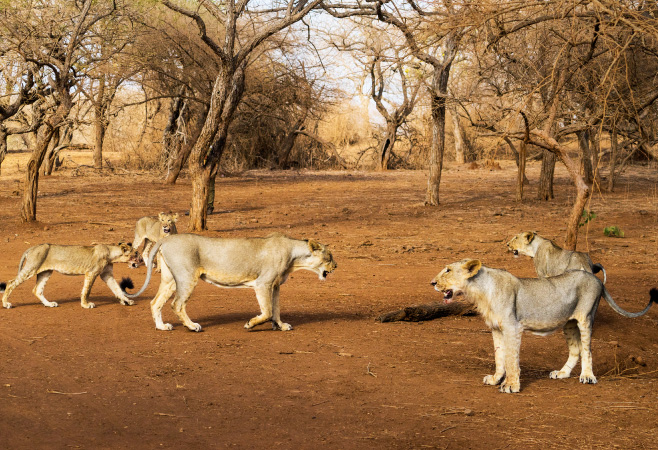 Gir National Park in Gujarat
2. Periyar Wildlife Sanctuary, Kerala
Periyar is an option for travellers who prefer viewing wildlife from the water. A trip on Periyar Lake may reveal elephants, deer, gaur, wild boar and waterbirds along the shore.
Boat programmes can differ by operator. Confirm the fare for your visitor category, trip duration, reporting point and reporting time when booking, including whether entry and transfers are charged separately. Choose a programme that suits your party rather than assuming every boat ticket has the same conditions.
3. Pobitora Wildlife Sanctuary, Assam
Pobitora combines grasslands and wetlands with a notable concentration of greater one-horned rhinos. Jeep safaris are one way to explore this compact sanctuary near Guwahati.
Assam Tourism describes it as approximately 30 km from the city; your road journey will depend on the starting point. Its suggested visiting season runs from mid-October to the end of March. Confirm safari operations and allow time for the return journey if visiting as a day trip.
4. Wayanad Wildlife Sanctuary, Kerala
Wayanad is a forest-wildlife destination with two main tourism areas: Muthanga in the south and Tholpetty in the north. Elephants, deer and other forest animals are among its attractions; seeing a tiger should be treated as a possibility rather than the purpose of a guaranteed encounter.
Choose the range that fits your route, then check its current safari arrangements, visitor-category tariff and vehicle capacity. Do not assume a ticket or schedule for one range applies to the other.
5. Indian Wild Ass Sanctuary, Gujarat
The Little Rann of Kutch offers a striking change from forest safaris: salt flats, seasonal wetlands and the Indian wild ass, or khur. Birdlife adds another reason to visit.
Gujarat Tourism recommends November to February for winter birdwatching and describes jeep excursions as a way to explore. Confirm the required forest permission and the guide and vehicle charges before booking. Plan around the access conditions for the particular route you intend to use.
 Coorg is a unique destination for nature lovers
6. National Chambal Sanctuary, North India
National Chambal stretches across parts of Uttar Pradesh, Madhya Pradesh and Rajasthan. Its river habitat supports gharials, freshwater dolphins, turtles and birds, making an authorized boat trip a different experience from a forest jeep safari.
UP Ecotourism lists 15 November to 15 June as an ideal visiting period for its destination page. This is not a guarantee that every boat service throughout the three-state sanctuary operates on those dates. Confirm the departure point, local permissions and river conditions separately.
7. Bhitarkanika Wildlife Sanctuary, Odisha
The Bhitarkanika destination includes a national park and surrounding sanctuary landscape. Mangrove creeks and estuaries are its defining habitats, with saltwater crocodiles and waterbirds among the main attractions.
Boat excursions suit travellers interested in wetlands rather than big-cat safaris. Odisha Tourism recommends October to March and lists a breeding-season closure from 1 May to 31 July. Check the latest local notice before fixing your dates, and confirm the boat route and permissions for the area you will visit.
8. Ranganathittu Bird Sanctuary, Karnataka
Near Mysuru, Ranganathittu is known for river islands used by nesting waterbirds. Guided boats offer views of species such as painted storks, spoonbills, cormorants and pelicans; mugger crocodiles may also be seen.
Confirm current opening hours, admission and boat charges directly with the sanctuary before travelling, as published pages do not agree on the schedule. Ask about boat operations for your date, particularly if river conditions could affect the visit.
9. Tal Chhapar Wildlife Sanctuary, Rajasthan
Tal Chhapar, in Churu district, is a grassland sanctuary known for blackbuck and birds. The open landscape provides a different setting from India's forests and river sanctuaries.
Ask forest staff which visitor routes and activities are permitted, keep a respectful distance from animals and check current entry charges. Do not assume that open grassland means unrestricted walking access or permission to approach wildlife for photographs.
10. Eaglenest Wildlife Sanctuary, Arunachal Pradesh
Eaglenest is a specialist forest-birding destination associated with the Bugun liocichla and other Eastern Himalayan birds. Incredible India recommends March and April for birdwatching. Arrange an experienced local guide and confirm access and accommodation before travelling.
Indian visitors should check the applicable Inner Line Permit rules. Foreign visitors should arrange the applicable Protected Area Permit (PAP) for Arunachal Pradesh and confirm any separate sanctuary permissions. An Indian visa alone does not authorize visits to protected or restricted areas. Consult Arunachal Tourism's PAP guidance and confirm the rules for your nationality and itinerary before booking.
How to choose the right sanctuary
- For a particular mammal: compare Gir for lions, Pobitora for rhinos, and the Little Rann for khur.
- For wildlife from a boat: compare Periyar's lake, Chambal's river and Bhitarkanika's mangroves.
- For birdwatching: consider Ranganathittu for waterbirds, Tal Chhapar for grassland birds and Eaglenest for specialist forest birding.
- For a family visit: choose an activity after checking its age rules, duration, safety arrangements, and facilities.
When should you visit?
There is no single best season for all ten sanctuaries. Winter can suit several lowland destinations, while Eaglenest has a different birding window. The individual entries above give useful starting points, but recommended seasons are different from confirmed operating calendars. Check local closures and weather before paying for transport or accommodation.
Practical tips for visiting wildlife sanctuaries
- Check access first. Confirm the tourism range, activity and any additional area permissions.
- Read the ticket conditions. Check visitor categories, identification requirements, cancellation rules and the separate charges for entry, vehicles, boats or guides.
- Book through the authority or an authorized provider. Make sure the permit covers the correct site, date and activity.
- Follow the guide's instructions. Keep your distance, avoid feeding animals and use only permitted routes. Stay in vehicles or boats when instructed, and follow the safety rules for any authorized walk.
- Keep expectations realistic. Wildlife watching depends on conditions, timing and chance.
FAQs about wildlife sanctuaries in India
Do I need to book a safari in advance?
Book early where advance reservations are available. Booking windows, quotas and cancellation rules vary by sanctuary and activity; there is no single advance-booking period for every destination in this list.
Which sanctuary should I choose for birdwatching?
Consider Ranganathittu for waterbirds, Tal Chhapar for grassland birds, National Chambal for river birds and Eaglenest for a specialist forest-birding trip. The right choice depends on your target species, time of year and preferred pace.
Are these visits suitable for children?
Check the specific programme's age restrictions, duration and safety arrangements. A boat trip, jeep safari and guided walk can have very different requirements; none should be assumed suitable for every child.
Are wildlife sanctuaries the same as national parks?
No. They are distinct protected-area categories in India, with different rules on access, permitted activities and resource use. Sanctuaries can protect habitats and ecological communities as well as individual species. Follow the rules for the particular site and tourism zone.
Does an Indian visa cover all the permissions for a sanctuary trip?
No. Entry permission for India, local wildlife tickets and any additional protected-area permissions are separate matters. Eaglenest visitors, in particular, should check the Arunachal Pradesh permit requirements before travelling.
Check your travel documents before booking
Review the India entry requirements for your passport, together with any valid Indian visa or other travel status you already hold. The route that applies depends on your documents and circumstances. Indian Immigration Services offers independent application assistance; decisions on visas and area permissions remain with the relevant authorities.
Check Out What’s In India