Visit the Taj Mahal: Complete Guide to Tickets, Entry & Travel Tips
Updated: June 22, 2026
The Taj Mahal is more than India's most famous landmark—it's one of the world's greatest architectural masterpieces and a symbol of eternal love. Located in the historic city of Agra, this UNESCO World Heritage Site attracts millions of visitors every year with its stunning white marble design, fascinating history, and cultural significance.
Whether you are planning your first trip to India or building an itinerary around the country's iconic attractions, this guide covers everything you need to know about visiting the Taj Mahal, including its history, opening hours, ticket prices, the best time to visit, and practical travel tips.
 Experience a breathtaking sunset view of the Taj Mahal
What Is the Taj Mahal?
The Taj Mahal is an ivory-white marble mausoleum built by the Mughal Emperor Shah Jahan in memory of his beloved wife, Mumtaz Mahal, who died in 1631. Construction began in 1632 and was largely completed by 1648, with surrounding structures and gardens finished a few years later.
Today, the Taj Mahal stands as one of the finest examples of Mughal architecture, blending Persian, Islamic, and Indian design influences. In 1983, it was designated a UNESCO World Heritage Site and is widely recognized as one of the New Seven Wonders of the World.
History of the Taj Mahal
The Taj Mahal was commissioned after the death of Mumtaz Mahal, the favorite wife of Shah Jahan. Historical records suggest that more than 20,000 artisans and craftsmen worked on the project, using marble transported from Rajasthan and precious stones sourced from across Asia.
The monument was designed not only as a royal tomb but also as a statement of the Mughal Empire's artistic and engineering achievements. Over the centuries, it has survived wars, environmental challenges, and changing dynasties to become India's most visited cultural attraction.
Where Is the Taj Mahal Located?
The Taj Mahal sits on the southern bank of the Yamuna River in Agra, Uttar Pradesh, roughly 220 km south of Delhi. Agra forms one corner of India's "Golden Triangle" tourist circuit, alongside Delhi and Jaipur, which makes the Taj Mahal easy to combine with a wider North India itinerary.
Taj Mahal Ticket Prices
Ticket pricing is set by the Archaeological Survey of India (ASI) and varies by nationality.
| Visitor Category | Garden/Complex Entry | Main Mausoleum Add-On | Total |
| Indian citizens / OCI cardholders | ₹50 | ₹200 | ₹250 |
| SAARC & BIMSTEC nationals* | ₹540 | ₹200 | ₹740 |
| Foreign tourists (all other nationalities) | ₹1,100 | ₹200 | ₹1,300 |
| Children under 15 | Free | Free | Free |
*SAARC/BIMSTEC countries include Bangladesh, Nepal, Bhutan, Sri Lanka, Pakistan, Afghanistan, Maldives, Myanmar, and Thailand.
A few important notes on pricing:
- The ₹200 mausoleum ticket is optional but worth it — it's your only way inside the inner chamber to see the cenotaphs and the famous marble inlay work up close.
- There are no standard student or senior citizen discounts; only the under-15 exemption applies.
- Online tickets are typically priced the same as gate tickets, though some platforms apply a small discount (around ₹5 for Indian tickets and ₹50 for foreign tickets when booked through the official portal).
- Tickets are valid only for the date and time slot selected — they're non-transferable to another day.
- No legitimate "skip-the-line" or VIP ticket exists. Booking online only lets you bypass the ticket counter queue, not the security/entry queue itself.
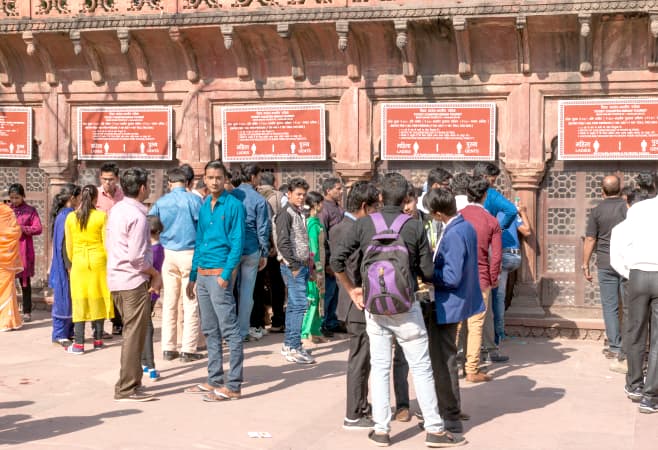 Book your Taj Mahal tickets online to save time and enjoy hassle-free entry
Night Viewing Tickets
The Taj Mahal opens for night viewing on five nights each month: the night of the full moon, plus two nights before and two nights after — except when that falls on a Friday, when the monument is closed regardless. Night viewing tickets are priced separately from daytime tickets and are usually only available in person at the ASI office in Agra, generally one day in advance. Group sizes are capped, and slots are limited, so book as early as the rules allow if a moonlit visit is on your list.
Taj Mahal Opening Hours
The Taj Mahal opens roughly 30 minutes before sunrise and closes 30 minutes before sunset, which means exact times shift through the year — earlier opening in summer, later in winter.
The monument is closed every Friday, a rule unrelated to ticket type or nationality.
Ticket counters at the gates operate from about one hour before sunrise until 45 minutes before sunset.
Entry Gates
There are three gates, but only two allow entry:
- West Gate (near Saheli Burj) — entry and exit
- East Gate — entry and exit
- South Gate — exit only, no entry permitted
If you've booked online, the East Gate is generally the more efficient choice for entry.
Step-by-Step: Mastering Your Arrival and Security
The area surrounding the Taj Mahal is classified as a protected eco-zone to mitigate yellowing of the marble from vehicular emissions (Kumar). No internal combustion engines are permitted within a 500-meter radius of the gates.
1. Arrive at the Designated Parking Zones (Shilpgram or Amalie)
Park your vehicle or get dropped off by your taxi/auto-rickshaw at the official staging points. The East Gate generally experiences slightly shorter queues than the West Gate.
2. Board Eco-Friendly Transit:5-minute ride
Hop onto an official electric golf cart, battery-operated bus, or traditional horse-drawn carriage (tonga) to travel the remaining distance from the parking hub to the monument's security checkpoints.
3. Purge Banned Items from Your Bags: Strict Security
Security is comparable to airport screenings. Banned items include: large backpacks, tripods, phone chargers, power banks, tobacco, drones, and food items. Carry only your passport, phone, camera, water bottle, and wallet.
4. Don your provided shoe covers before stepping onto the marble
Foreign ticket holders receive a complimentary water bottle and a pair of fabric shoe covers. You must put these covers over your footwear before stepping onto the elevated red sandstone and white marble platforms.
 Step inside the Taj Mahal to admire its exquisite marble inlay, intricate calligraphy, and the historic mausoleum of Mumtaz Mahal
Best Time to Visit the Taj Mahal
Best Time of Day
Sunrise is the single most recommended time to visit. The crowds are thinnest, temperatures are cooler, and the marble takes on a soft pink tone as the light shifts — a very different mood from the stark white glare of midday.
Entry on sunrise slots generally opens around 6:00 AM, though exact timing depends on the season.
If sunrise isn't realistic for your schedule, late afternoon is the next best option, both for lighting and for slightly thinner crowds compared to midday.
Best Time of Year
The season from October to March is regarded as the best time to visit, as it will be cooler with more pleasant temperatures for sitting outside in line for food and walking through the gardens.
The heat of summer (April-June) is quite extreme and makes midday visits truly uncomfortable; the monsoon months (July-September) are humid with occasional heavy rain, but also with fewer people around and some great scenery for photographers.
How to Reach the Taj Mahal
By Air
Agra has an airport, but most international travelers arrive in New Delhi and continue to Agra by train or road.
By Train
Agra is well connected by rail with the following major stations:
- Agra Cantt Railway Station
- Agra Fort Railway Station
- Raja Ki Mandi Railway Station
There are a number of fast and express trains running from Delhi to Agra every day.
By Road
The Yamuna Expressway provides one of the fastest road connections between Delhi and Agra that will cut the travel time between Delhi and Agra from 4-5 hours by car or bus to 3-4 hours.
Getting Around Agra
Once in Agra, the Taj Mahal complex itself is a no-vehicle zone within a certain radius for environmental protection. Visitors park at a distance and either walk or take an electric shuttle/battery vehicle (a nominal fee, typically ₹10–20 one-way) to reach the gates.
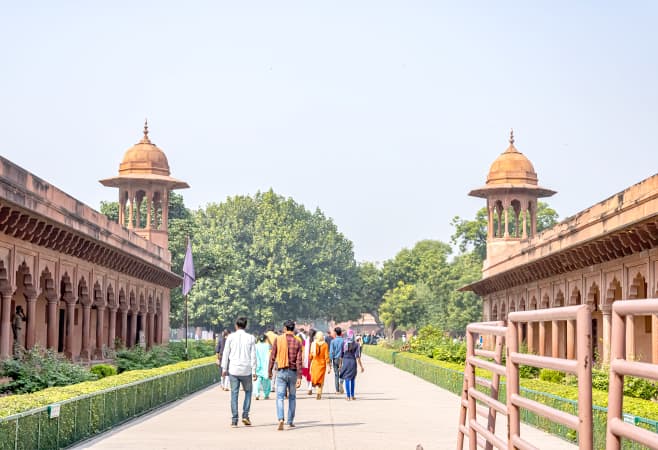
 Discover the gardens, reflecting pools, mosque, and magnificent white marble architecture during your visit to the Taj Mahal complex
What to Expect Inside: A Practical Walkthrough
- Bag and security checks are enforced. This is because large bags, food, tripods, drones, power banks (over a certain capacity), and smoking materials are not allowed.
- The first sighting of the Taj Mahal is through the Great Gate (Darwaza), specifically designed to make the mausoleum seem larger as you approach it.
- The charbagh garden and reflecting pool both directly lead towards the main platform, which is the most popular shot that visitors flock to.
- Visitors have to remove their shoes or wear shoe covers, which will be provided (usually as part of the entry fee for the mausoleum).
- Photography is limited or prohibited in some parts of the mausoleum; please consult current signage. Rules are enforced strictly and inconsistently applied. Any advice from a tout to avoid them should be discounted.
- Each of the gardens, the mosque, the Jawab (the building that mirrors the mosque for symmetry reasons), and the mausoleum itself will take 2 to 3 hours to view at leisure.
Beyond the Taj: What Else to See Nearby
For all those who have visited the Taj, there is much more to see in its surrounding area. The Taj Mahal is almost always visited in conjunction with at least one or two of the other sites at Agra:
- Agra Fort — A red sandstone Mughal fortress about 2.5 km from the Taj Mahal, where Shah Jahan was reportedly imprisoned by his son Aurangzeb in his final years, with a view of the Taj Mahal from his confinement.
- Itimad-ud-Daulah ("Baby Taj") — A smaller marble tomb that predates the Taj Mahal and is thought to have influenced its design.
- Mehtab Bagh — A garden directly across the Yamuna River, offering one of the best unobstructed views of the Taj Mahal's rear façade, especially at sunset.
Common Mistakes to Avoid
Friday is the day they come! The monument is closed on Fridays—Please check the itinerary date before booking transport or tours, as the monument is closed on Fridays.
Buying the ticket and then declining to enter the mausoleum. Passing on the entry to the mausoleum in order to save money. The add-on of ₹200 takes you inside to see the real tombs and detailed inlay work; otherwise, you just see the exterior.
Purchasing tickets from illegal gate agents. Only buy tickets from the official ASI ticketing site or reputable travel companies and avoid paying extra for "VIP" tickets sold at unofficial ticket booths near the entrance.
In summer, arriving at midday. There is little shade from the marble surface, and the open plaza and the heat are severe (roughly 11 AM-3 PM) from April through June.
Lacking a valid photo ID. At entry, identification is required, especially for paying fees based on the nationality of the applicant.
Frequently Asked Questions About Taj Mahal in India
Is the Taj Mahal open every day?
No. It is closed every Friday. Open during the remainder of the week from around 30 minutes before sunrise to 30 minutes before sunset.
How much does it cost to enter the Taj Mahal?
Indian citizens pay ₹250 total (with mausoleum access), SAARC/BIMSTEC nationals pay ₹740, and foreign tourists pay ₹1,300. Children under 15 enter for free.
Can I book Taj Mahal tickets online?
Yes, tickets can be booked through the official ASI ticketing portal or authorized travel platforms. Online booking saves time at the gate but doesn't bypass security screening.
What is the best time to visit the Taj Mahal?
Sunrise offers the best light and the smallest crowds. October through March is the most comfortable season weather-wise.
Can the Taj Mahal be visited as a day trip from Delhi?
Yes. The Gatimaan Express train makes a same-day round trip from Delhi to Agra, departing early morning and returning by evening.
Is photography allowed inside the Taj Mahal?
Photographs are permitted in gardens and outside areas. Photography rules inside the mausoleum may change. Follow current signage and instructions from on-site staff.
Do I need a guide?
A licensed guide is not required, but will give historical and architectural depth as well, especially regarding the symbolism of the inlay work and calligraphy that can easily be overlooked on a self-guided tour.
How long does a Taj Mahal tour take?
2–3 hours standard; 3–4 hours for sunrise photos + mausoleum.
Is it possible to visit the Taj Mahal at night?
Yes – Night viewing is available on selected nights around the full moon. Check current ASI booking procedures before making plans.
Is the child under 15 years of age free?
Yes – children below 15 years old enter free (Indian and foreigners).
Is it safe to travel to the Taj Mahal solo?
Yes – very safe, standard tourist precautions apply (don't be taken aback by scams, keep valuables close).
Final Thoughts
The Taj Mahal is not simply a monument—it is a timeless symbol of India's rich history, artistry, and cultural heritage. From its extraordinary marble craftsmanship to the romantic story behind its creation, every part of the complex offers something memorable for visitors.
Whether you are traveling through India's Golden Triangle or planning a dedicated cultural tour, the Taj Mahal remains an essential destination and one of the most remarkable architectural achievements ever built.
Check Out What’s In India